Artificial Intelligence is rapidly evolving from isolated chatbot implementations into enterprise-wide intelligent systems capable of reasoning, orchestrating workflows, interacting with business applications, and operating autonomously across digital ecosystems.
As organizations move deeper into AI adoption, the conversation is no longer centered on whether businesses should use AI. The focus has shifted toward how enterprises can build scalable, secure, interoperable, and production-ready AI infrastructures that align with operational complexity and long-term digital transformation goals.
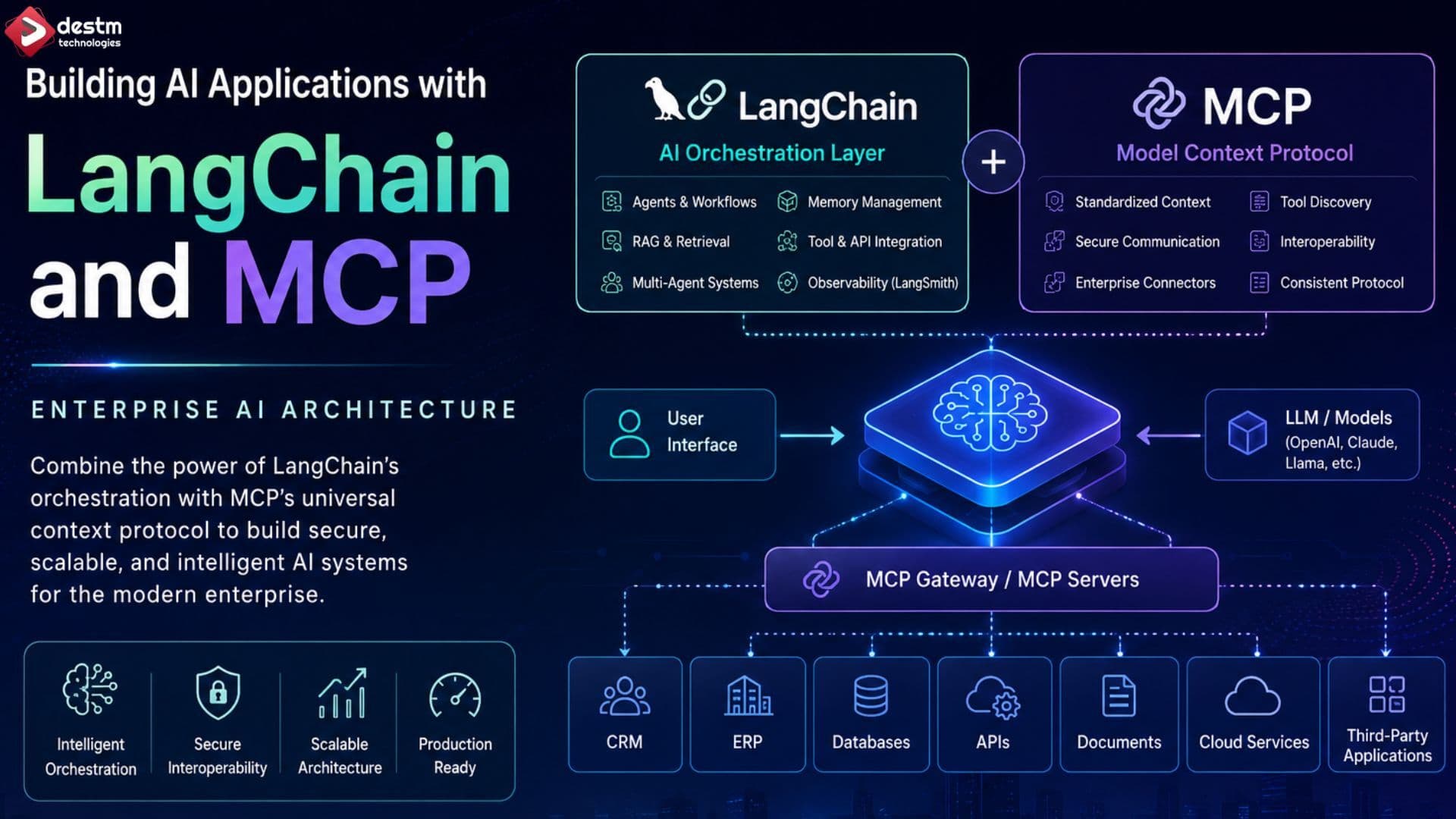
This transition has introduced a new architectural paradigm built around AI orchestration frameworks, agent-based systems, and standardized context protocols. Among the technologies driving this evolution, LangChain and the Model Context Protocol (MCP) are emerging as foundational components of modern enterprise AI architecture.
Together, they are redefining how enterprises design AI-native applications capable of connecting models, workflows, enterprise systems, APIs, and data environments into unified intelligent ecosystems.
The first generation of enterprise AI applications was largely centered around prompt-response interactions. Organizations experimented with chat interfaces, support assistants, and isolated automation use cases that depended heavily on static prompts and limited context awareness. However, modern enterprise environments require AI systems that can:
This shift is driving the emergence of AI-native enterprise architecture — an approach where AI becomes part of the operational infrastructure itself rather than a standalone feature layer.
In this new model, AI systems function less like assistants and more like intelligent operational agents embedded directly into enterprise processes.
Built with CuberiQ
LangChain has become one of the most influential frameworks for developing enterprise AI applications powered by Large Language Models (LLMs).
At its core, LangChain acts as an orchestration framework that enables developers to design complex AI workflows capable of integrating reasoning, memory, retrieval systems, APIs, and autonomous agents.
Rather than treating language models as isolated interfaces, LangChain transforms them into programmable systems capable of interacting with enterprise infrastructure in a structured and scalable manner.
Modern enterprise implementations of LangChain increasingly involve:
The evolution of LangChain into platforms such as LangGraph and LangSmith further reflects the growing demand for production-grade agent engineering environments capable of supporting enterprise-scale deployments.
This evolution is particularly important because enterprises are no longer building simple AI applications. They are building intelligent operational systems.
Model Context Protocol (MCP) represents one of the most important architectural developments in enterprise AI interoperability.
MCP provides a standardized framework that enables AI systems to securely communicate with external tools, APIs, databases, enterprise applications, and contextual data sources.
In many ways, MCP is becoming the equivalent of a universal communication layer for AI systems.
Without standardized protocols, enterprise AI environments become fragmented. Every AI agent requires custom integrations, proprietary connectors, and isolated communication logic for interacting with enterprise systems.
This creates operational inefficiencies, scalability limitations, and governance challenges.
MCP addresses this problem by standardizing how AI systems:
The significance of MCP lies not only in connectivity, but in architectural standardization.
As enterprises scale AI adoption, standardized communication layers become essential for maintaining governance, flexibility, and operational consistency across AI ecosystems.
One of the most common misconceptions in enterprise AI discussions is the assumption that LangChain and MCP compete with one another.
In reality, they operate at entirely different architectural layers.
LangChain focuses on orchestration and reasoning. MCP focuses on interoperability and contextual communication.
LangChain manages how AI systems think, plan, reason, and execute workflows.
MCP manages how AI systems communicate with enterprise infrastructure.
Together, they create a layered enterprise AI architecture where:
This separation of concerns is critical for scalability.
Rather than tightly coupling AI logic with infrastructure integrations, enterprises can build modular AI architectures where orchestration and connectivity evolve independently.
Enterprise software is increasingly transitioning toward what many industry experts now describe as the “Agentic Enterprise.”
In this emerging model, organizations deploy autonomous or semi-autonomous AI agents capable of executing operational tasks, coordinating workflows, accessing systems, and making context-aware decisions.</br
Unlike traditional automation tools, AI agents operate dynamically.
They can reason through objectives, determine execution paths, retrieve information from multiple systems, and collaborate with other agents to complete business processes.
This fundamentally changes enterprise architecture.
Traditional enterprise systems were designed around deterministic workflows and predefined logic.
Agentic systems introduce adaptive intelligence into operational infrastructure.
As a result, modern enterprise AI architecture increasingly includes:
This transformation is creating a new software paradigm where AI is no longer an interface layer but an operational layer.
The integration of LangChain and MCP creates a highly scalable architecture for enterprise AI deployment.
Consider a financial analytics assistant operating within a global enterprise environment.
A user requests a quarterly revenue forecast.
The LangChain orchestration layer interprets the request, determines workflow requirements, identifies relevant systems, and coordinates the reasoning process.
MCP then enables secure communication with enterprise resources such as:
The retrieved data is passed back into the orchestration layer, where the AI system synthesizes insights, generates forecasts, and produces contextual recommendations.
This architecture enables enterprises to build AI systems that function as operational collaborators rather than isolated interfaces.
The importance of this approach becomes even more significant in environments involving multi-agent coordination, cross-platform workflows, and distributed enterprise infrastructure.
One of the most important developments in enterprise AI architecture is the growing emphasis on context engineering.
Early AI systems relied heavily on prompt engineering, where developers attempted to optimize responses through carefully structured prompts.
Modern enterprise AI systems require far more sophisticated contextual frameworks.
AI applications now need to maintain:
This is where enterprise memory systems become essential.
LangChain supports memory orchestration mechanisms that allow AI agents to retain operational awareness across workflows and interactions.
MCP further strengthens this capability by standardizing how contextual information is shared across systems and services.
The future of enterprise AI will increasingly depend on how effectively organizations manage context, memory, and reasoning continuity across distributed environments.
Retrieval-Augmented Generation (RAG) has become a core architectural pattern in enterprise AI systems.
Rather than relying solely on pre-trained model knowledge, RAG systems retrieve real-time enterprise data during inference.
This dramatically improves:
In enterprise environments, RAG pipelines often connect AI systems to:
LangChain enables orchestration of these retrieval pipelines, while MCP standardizes secure communication with enterprise data sources.
This combination creates highly dynamic enterprise intelligence systems capable of operating with real-time contextual awareness.
As enterprises move toward AI-native operations, governance becomes one of the most critical architectural considerations.
AI systems are increasingly gaining access to sensitive operational infrastructure, financial systems, customer data, and internal decision-making workflows.
This creates substantial security and compliance challenges.
Organizations adopting MCP-based architectures must implement strong controls around:
Zero-trust AI architecture is becoming an emerging best practice for enterprise deployments.
In this model, every AI interaction is treated as potentially sensitive and requires verification before execution.
Human-in-the-loop governance mechanisms are also becoming increasingly important, particularly in industries involving financial operations, healthcare systems, compliance workflows, and enterprise risk management.
The future of enterprise AI will depend not only on intelligence capabilities, but also on the ability to deploy these systems responsibly and securely.
The combination of LangChain and MCP is enabling a wide range of enterprise AI use cases across industries.
In customer support environments, AI agents can access ticketing systems, retrieve customer history, summarize interactions, and coordinate workflow automation across service channels.
In enterprise sales operations, intelligent agents can analyze CRM pipelines, generate forecasting insights, automate reporting, and coordinate revenue intelligence workflows.
Supply chain organizations are using AI systems to optimize logistics operations, analyze inventory movement, forecast procurement needs, and automate operational coordination across distributed infrastructure.
Engineering organizations are deploying AI-powered developer assistants capable of analyzing repositories, reviewing infrastructure, supporting DevOps operations, and orchestrating deployment pipelines.
These systems are rapidly moving from experimental initiatives into core operational infrastructure.
The enterprise AI ecosystem is evolving toward protocol-driven, interoperable, and agent-oriented infrastructure.
Organizations are increasingly recognizing that long-term AI scalability depends on architecture rather than isolated model performance.
This is why technologies like LangChain and MCP are becoming strategically important.
They provide the structural foundation required to build:
As AI adoption accelerates, enterprises that establish strong architectural foundations today will be significantly better positioned to scale autonomous operations, improve decision intelligence, and create competitive operational advantages.
Enterprise AI is entering a new era defined by orchestration, interoperability, memory systems, and intelligent operational infrastructure.
The future of AI applications will not be built around isolated models or standalone chatbots. It will be built around interconnected AI ecosystems capable of reasoning, coordinating, retrieving context, and operating securely across enterprise environments.
LangChain provides the orchestration framework that enables intelligent workflow execution and agent coordination.
MCP provides the interoperability layer that standardizes communication between AI systems and enterprise infrastructure.
Together, they form the foundation of modern enterprise AI architecture.
As organizations transition toward AI-native operations, the ability to design scalable, governed, and context-aware AI systems will become one of the defining competitive advantages of the next decade.Enterprise AI is rapidly evolving beyond standalone chatbots into interconnected, AI-native ecosystems powered by orchestration, interoperability, memory, and intelligent automation.
LangChain enables enterprises to build scalable AI workflows and agent systems, while MCP standardizes secure communication between AI models, enterprise applications, APIs, and data environments. Together, they form the foundation of modern enterprise AI architecture.
As businesses move toward autonomous and context-aware operations, organizations that invest early in scalable and governed AI infrastructure will gain a significant competitive advantage.
At Destm Technologies, we help enterprises build future-ready AI ecosystems through intelligent automation, cloud-native engineering, and advanced AI-driven commerce and enterprise solutions designed for the next generation of digital transformation.
Ready To Transform Your E-commerce Business?
Let's discuss your project and explore how we can help you achieve your goals.