Magento / Adobe Commerce
Magento expertise. Enterprise scale.
Magento Open Source, Adobe Commerce, and Cloud — custom development, complex migrations, and performance optimization for high-growth commerce.
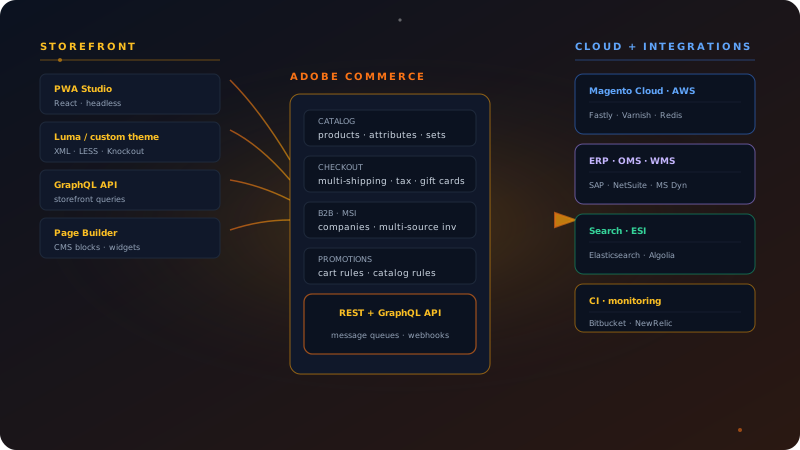
The Adobe Commerce architecture we build
Storefront, core, and infrastructure — engineered as one system.
Edge Delivery Services or Hyvä in front — with PWA Studio still supported where you already run it — Adobe Commerce in the middle, Magento Cloud or AWS underneath, ERP / OMS / WMS wired in. Multi-store, B2B, and search tuned for catalogs in the millions.
Services
What we build on Magento.
Full-spectrum Magento engineering — from new builds to complex migrations and the performance tuning behind a 40% page-load improvement on our last Adobe Commerce migration.
Magento 2 development
Custom storefronts, theme development, and full-stack engineering on Magento Open Source.
Adobe Commerce Cloud
Adobe's managed cloud — auto-scaling, blue/green deploys, hardened CI/CD with rollback windows tested before launch.
Magento 1 to 2 migration
Complete platform migration including data, customizations, integrations, and SEO.
Custom module development
Bespoke modules for payment gateways, shipping, ERP connectors, and custom workflows.
B2B commerce solutions
Company accounts, custom pricing tiers, requisition lists, and approval workflows.
Multi-store & multi-language
Global architecture with multiple store views, localized content, and multi-currency.
Performance tuning
Varnish caching, Redis, Elasticsearch tuning, database optimization, and CDN configuration.
Security hardening
Security audits, patch management, WAF configuration, PCI compliance, and vulnerability scanning.
Migration partnership
Cutover with a minimal maintenance window.
Multi-million SKU catalogs. Cutover with a minimal maintenance window. SEO surface mapped end to end.
Our migration framework handles data mapping, URL rewrites, custom attribute preservation, and integration re-wiring — all validated through automated regression testing before cutover.
7M+
Products migrated
40%
Faster page loads (beauty brand migration)
78% → 52%
Checkout abandonment (beauty brand migration)
The Destm migration timeline
Magento → headless cutover, week by week.
Every Magento migration we run follows the same 6-phase shape. Risk markers below show where most teams trip — and where our framework de-risks before cutover.
Discovery + audit
Schema map, integration inventory, traffic shape, custom-attribute scan. Output: gap list + risk register.
Data mapping + dual-write
Source-of-truth defined per entity. Dual-write live so both stacks stay in sync during cutover. Reconciliation jobs catch drift.
Frontend rebuild
Hydrogen / Next.js storefront against the new backend. Component-by-component porting with parity tests. URL structure preserved.
SEO + integrations
Redirect map (1:1), schema-org parity, sitemap regen, GA4 + GTM continuity. Payment + ERP + 3PL connectors re-wired.
Soft launch (10%)
Traffic split via edge — 10% on the new stack, 90% on Magento. Real-user metrics + revenue parity validated for 7 days minimum.
Full cutover
DNS flip during your low-traffic window. Magento kept warm read-only for 30 days. Rollback path documented and tested.
Result
Cutover with a minimal maintenance window. SEO surface mapped. Revenue protected.
Migration guide
On Magento Open Source 2.4.6? Support ended this month.
Magento Open Source 2.4.6 left support on 11 August 2026, and Open Source gets no extended-support window. Licensed Adobe Commerce on the same version is covered to 31 August 2027, so the urgency depends entirely on which one you run. Magento 1 has been unsupported since 2020 and is a different conversation again.
Support dates per Adobe’s published lifecycle policy. We will tell you which track you are on before we quote anything.
Why you must migrate
- No more security patches — every day on Magento 1 increases your breach risk
- PCI compliance auditors flag Magento 1 as a critical vulnerability
- Payment processors are dropping support, limiting your checkout options
Your migration options
Magento 2 / Adobe Commerce
Stay in the Magento ecosystem with a modern architecture. Best if you have heavy customizations, complex B2B logic, or multi-warehouse operations that depend on Magento-specific modules.
Shopify Plus
Move to a managed platform with lower operational overhead. Best for D2C brands that want to focus on growth, not infrastructure. Hydrogen provides headless flexibility without the server management burden. See our Magento-to-Shopify-Plus migration guide.
Composable commerce
Assemble specialist services — headless CMS, commerce API, search, payments — into a custom stack. The right move for brands with complex multi-channel needs and a strong engineering team.
The Destm migration approach
- Parallel environment — your new platform is built and validated while your current store keeps running
- Minimal-downtime cutover with a rehearsed rollback if anything looks wrong post-launch
- Data and SEO migration — products, customers, orders, URL mapping with redirects, and post-launch rank monitoring
Migration control center
Every risk has a control and an evidence trail.
An Adobe Commerce migration is a controlled program, not a theme rebuild. Each dimension is owned, mitigated, and proven before cutover.
| Risk | How we control it | Launch evidence |
|---|---|---|
| SEO | URL inventory + 301 map + metadata parity | Redirect + rank report |
| Catalog data | Mapped, migrated, and diffed against source | Row-count reconciliation |
| Customer & orders | Migrated with totals reconciled | Finance sign-off |
| Extensions | Re-implemented or replaced, not lifted | Feature-parity checklist |
| Checkout | Parity-proven on staging under load | Load-test pass |
| ERP / OMS | Tested against real volume + failure cases | Integration test suite |
| Rollback | Scripted and rehearsed before cutover | Dry-run log |
The same control plan runs on every platform migration.
Where we built
Minimal-downtime Magento 2 migration for a beauty brand.
40%Faster page loads — checkout abandonment down from 78% to 52%
Read the case studyAdjacent solutions